Culture
Anishinaabe art, stewardship and repatriation move to the center at Michigan museums
The Grand Rapids Public Museum reopens its Anishinaabek exhibition on Indigenous Peoples’ Day after a two-year redesign shaped with tribal advisors.
By Staff · October 21, 2026
Traditional drumming, singing and dance filled the Grand Rapids Public Museum on Oct. 10, 2026, as hundreds of Michigan tribal citizens and allies gathered for a powwow two days before the museum reopened “Anishinaabek: The Original People of This Place” on Indigenous Peoples’ Day. The room they came to celebrate was built in collaboration with Michigan’s Anishinaabe communities and the museum’s Eshtoojik Advisory Council, whose name translates to “the ones who create.”
The public reopening on Monday, Oct. 12, 2026, followed roughly two years of renovation; the earlier version of the exhibition had stood since 1994. Saturday’s powwow included Indigenous art and food and craft vendors, and drum groups Ribbontown, Iron Bear and Sharp Feather performed with adult and youth dancers. Shannon Martin of the Gun Lake Tribe emceed, and George Martin of the Lac Courte Oreilles Band of Lake Superior Chippewa Indians served as head veteran.
Katrina Furman, the museum’s Anishinaabe curator and a member of the Grand Traverse Band of Ottawa and Chippewa Indians, led the curatorial work with the advisory council, which represents federally and state-recognized tribal governments and began reviewing content and providing cultural guidance in 2023. Furman said the museum “collaborated with the Anishinnaabek community to create a space that is welcoming, engaging, and honest,” and described the exhibition as “the collaborative efforts of Anishinaabe and Museum communities, as well as the time and talents of countless artists, knowledge keepers and craftspeople.”
The redesign’s central message is “We Are Still Here,” foregrounding Anishinaabe continuity, contemporary identity, tribal sovereignty, veterans and community leaders. It delivers that through holographic storytelling, immersive seasonal-village projections, interactive screens, LED panels, oral histories, the Anishinaabe language, contemporary music, works by local Anishinaabe artists, a Veterans Wall of Honor and murals.
A fifth-generation quillwork artist in East Lansing
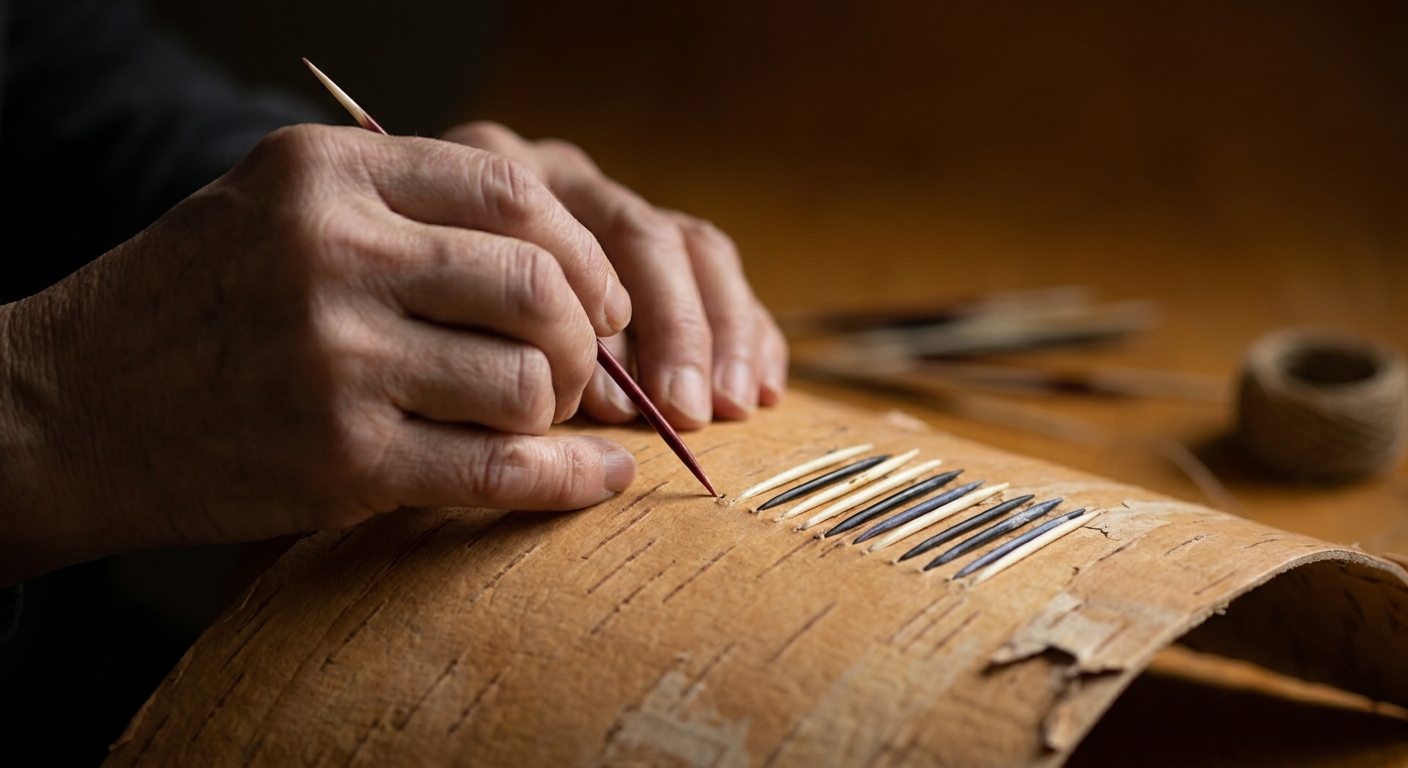
Across the state at the MSU Museum in East Lansing, “Gaawii Eta-Go Aawizinoo Gaawiye Mkakoons / It’s Not Just a Quill Box” — described as the first major traveling exhibition devoted to Anishinaabe porcupine-quill art — opened Sept. 1, 2026, as its final tour stop.
The show brings together nearly 90 porcupine-quill works by contemporary Anishinaabe artists from Michigan, Wisconsin, Minnesota and Manitoulin Island, Canada, drawn from public and private collections. It is presented bilingually in Anishinaabemowin and English, with material-harvesting documentation, process videos and interactive panels.
Featured artist Monica Jo Raphael is a fifth-generation quillwork artist, knowledge keeper and curator of Great Lakes Native art and cultures, with ties to the Grand Traverse Band of Ottawa and Chippewa Indians, Sičáŋğu Lakota through Chief Spotted Tail, and Huron and Pokagon Potawatomi ancestry. She said she is “just so proud of the exhibition because it puts our members first,” and added that the show “features pieces by today’s quillwork artists or those within living memory, along with stories of their Ancestors whose knowledge has been passed down through generations.”
Raphael said quillwork depends on “learned knowledge and respectful harvesting” of porcupine quills and other plant and animal materials, not merely on stitching skill. She gave a well-attended quillwork demonstration and talk Sept. 30, and an Oct. 18 hands-on quillwork workshop, a Nov. 4 Native American Heritage poetry reading and further workshops and programs are planned through the run.
Repatriation talk puts tribal nations at the table
The MSU Museum also hosted a public panel, “Bringing Them Home: A Tribal Panel on NAGPRA, Repatriation, and Collections Across Campus,” on Friday, Oct. 16, from 2:15 to 4:15 p.m. in the MSU Museum Commons, during Indigenous Peoples’ Day week. MSU Museum NAGPRA program manager Dr. Jessica Yann moderated.
Panelists included Rebecca Rupe, archives and collections coordinator and NAGPRA representative for the Match-E-Be-Nash-She-Wish Band of Pottawatomi Indians, and Marie Richards, an archaeologist and citizen of the Sault Ste. Marie Tribe of Chippewa Indians. William Johnson, curator and operations manager at the Ziibiwing Center of Anishinabe Culture and Lifeways and NAGPRA designee for the Saginaw Chippewa Indian Tribe, was listed but could not attend because of travel delays.
Rupe told the audience, “You guys have great big collections, unethically usually sourced. So transparency and community (are vital when) working with tribes, especially removed tribes,” and added that universities should be transparent with Native students about such materials. Richards said repatriation asks universities to set aside conventional ideas of institutional ownership and instead prioritize enduring relationships and care for Indigenous ancestors and belongings.
Michigan State gave notice Sept. 23, 2026, of its intent to repatriate 37 cultural items to the Keweenaw Bay Indian Community under NAGPRA — one copper pike and 36 sacred objects and/or objects of cultural patrimony — with repatriation possible on or after Oct. 23, 2026. University NAGPRA records also note that ancestors were returned to the Little River Band of Ottawa Indians on June 1, 2023. Filmmakers Adam and Zack Khalil, citizens of the Sault Ste. Marie Tribe of Chippewa Indians, spent eight years documenting the Michigan Anishinaabek Cultural Preservation and Repatriation Alliance’s work to recover ancestors held by MSU for their documentary “Aanikoobijigan,” screened alongside the repatriation programming at the MSU Broad Art Museum.
If you go
In Grand Rapids, the exhibition is included with general admission at the Grand Rapids Public Museum, 272 Pearl Street NW.
In East Lansing, the quillwork exhibition is on view at the MSU Museum through Jan. 30, 2027, though the museum has also published a Nov. 25, 2026 closing date; visitors should check before going. The Oct. 18 quillwork workshop and the Nov. 4 Native American Heritage poetry reading are planned, and further workshops and programs are scheduled through the run.
Taken together, the openings and panel mark a shift from displaying Anishinaabe culture to letting Anishinaabe people direct how it is shown and cared for. In Grand Rapids, the advisory council reviewed content and shaped the room; in East Lansing, Raphael’s knowledge guides the quillwork show; and on campus, tribal NAGPRA representatives discuss what is returned. Living communities are setting the terms.